K-Drama Ad Revenue Soars 10% in Q4 2025: 2026 Marketing Insights

The 10% increase in K-Drama advertising revenue on U.S. platforms in Q4 2025 indicates a robust and growing market, necessitating strategic adjustments for marketers aiming to leverage this expanding viewership in 2026.
The landscape of digital entertainment is ever-shifting, and one of the most compelling narratives emerging is the significant surge in K-Drama popularity. The recent report detailing a 10% increase in K-Drama advertising revenue on U.S. platforms in Q4 2025 is not just a statistic; it’s a powerful indicator of evolving consumer preferences and a clarion call for marketers to recalibrate their strategies for 2026.
Understanding the Q4 2025 Surge in K-Drama Advertising Revenue
The remarkable 10% increase in K-Drama advertising revenue on U.S. platforms during Q4 2025 underscores a pivotal moment in the entertainment industry. This growth isn’t a fleeting trend but rather a reflection of sustained and escalating viewer engagement with Korean content, particularly within the American market. Understanding the underlying factors contributing to this surge is crucial for crafting effective marketing campaigns moving forward.
Several elements have converged to fuel this impressive financial uptick. The quality of K-Drama production, coupled with diverse storytelling that transcends cultural boundaries, has captivated a broad spectrum of U.S. audiences. This sustained interest has translated directly into higher viewership numbers, creating a fertile ground for advertisers seeking engaged and receptive consumers.
Factors Driving K-Drama Popularity
The appeal of K-Dramas stems from a multifaceted approach to content creation. High production values, compelling narratives, and a consistent output of fresh material all contribute to their growing global footprint. These dramas often explore universal themes while offering unique cultural perspectives, making them resonate with a diverse audience.
- High Production Quality: Visually stunning cinematography and intricate plotlines elevate the viewing experience.
- Diverse Storytelling: From romantic comedies to intense thrillers, K-Dramas offer a wide range of genres.
- Accessibility: Major streaming platforms have made K-Dramas readily available with subtitles, breaking down language barriers.
- Cultural Exchange: Viewers are increasingly interested in exploring different cultures through entertainment.
The Role of Streaming Platforms
Streaming giants have played an indispensable role in the dissemination and popularization of K-Dramas in the U.S. By actively acquiring and promoting Korean content, these platforms have not only expanded the reach of these shows but also cultivated a dedicated fanbase. Their sophisticated recommendation algorithms further expose new viewers to K-Dramas, perpetuating the cycle of discovery and engagement. This strategic investment by platforms directly correlates with the rise in advertising opportunities and, subsequently, revenue.
In conclusion, the Q4 2025 surge in K-Drama advertising revenue is a clear signal of the genre’s robust health and expanding influence in the U.S. market. This growth is driven by a combination of high-quality content, diverse storytelling, and strategic platform distribution, all of which create a highly attractive environment for advertisers.
Audience Demographics: Who is Watching K-Dramas in the U.S.?
Delving into the demographics of K-Drama viewers in the U.S. is paramount for marketers aiming to effectively capitalize on the rising advertising revenue. The audience is far more diverse than often perceived, extending beyond initial niche groups to encompass a broad, engaged, and valuable consumer base. Understanding these segments allows for precision targeting and more impactful campaign development.
Initial perceptions might have pegged K-Drama fans as primarily young, female, and of Asian descent. While these groups remain significant, recent data indicates a substantial broadening of the audience. The universal themes of love, family, ambition, and conflict, often explored with unique cultural nuances, resonate across various age groups, genders, and ethnic backgrounds. This expansion creates a richer, more varied target for advertisers.
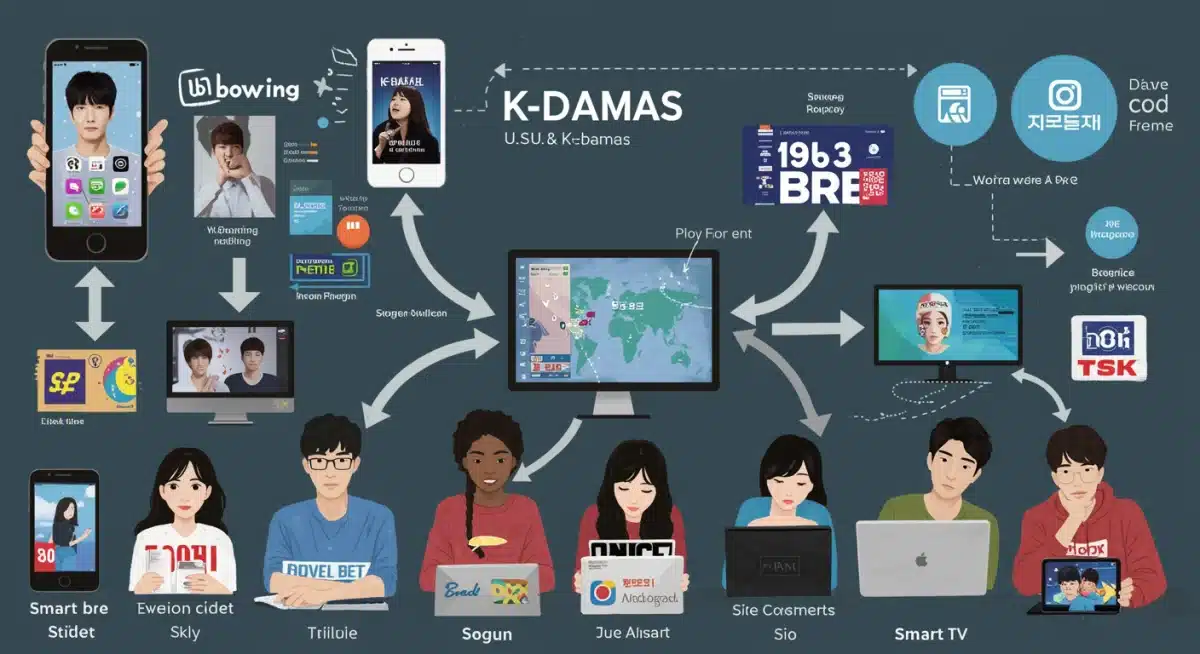
Key Demographic Insights
Recent studies and platform analytics reveal surprising breadth in the K-Drama viewership. While Gen Z and millennials are still dominant, there’s a noticeable uptick in older demographics discovering and enjoying these shows. This indicates a growing mainstream acceptance and appreciation for Korean content.
- Age Range: Significant engagement from 18-34, but growing interest in 35-54 age bracket.
- Gender Balance: While historically female-dominated, male viewership is steadily increasing.
- Geographic Spread: Strongholds in coastal cities but rapidly expanding into heartland regions.
- Income Levels: A broad distribution, suggesting mass appeal rather than an exclusive niche.
Psychographics and Consumer Behavior
Beyond basic demographics, understanding the psychographic profile of K-Drama viewers offers deeper insights. These audiences are often early adopters of technology, highly engaged with social media, and open to international cultural experiences. They tend to be discerning consumers who value authenticity and quality. Their engagement with K-Dramas often extends to other aspects of Korean culture, including food, fashion, and beauty, creating cross-promotional opportunities.
In essence, the K-Drama audience in the U.S. is a dynamic and expanding group characterized by diversity and high engagement. Marketers who invest in understanding these nuances will be better positioned to create resonant and effective campaigns that truly connect with this valuable consumer segment, thereby maximizing their return on investment in a market where K-Drama advertising revenue is demonstrably growing.
Implications for 2026 Marketing Strategies: Seizing the Opportunity
The 10% surge in K-Drama advertising revenue in Q4 2025 is a clear directive for marketers: 2026 strategies must adapt to this burgeoning landscape. Ignoring this trend would mean missing out on a highly engaged and growing audience segment. The opportunity lies in integrating K-Drama content and its cultural resonance into broader marketing frameworks, moving beyond traditional advertising approaches.
Marketers need to shift their focus from simply placing ads around K-Drama content to more deeply embedding their brands within the K-Drama ecosystem. This involves understanding the narratives, character archetypes, and aesthetic sensibilities that define the genre. Authenticity and cultural sensitivity will be key differentiators for brands looking to connect meaningfully with this audience.
Strategic Approaches for Brand Integration
Effective brand integration goes beyond simple product placement. It involves a nuanced understanding of how products and services can naturally fit into the K-Drama world, enhancing the viewer’s experience rather than disrupting it. This requires collaboration with content creators and a willingness to embrace new forms of storytelling.
- Product Placement & Sponsorships: Seamless integration of products within K-Drama narratives.
- Influencer Marketing: Collaborating with K-Drama actors or fan influencers to promote brands.
- Co-Branded Content: Creating original content that merges K-Drama themes with brand messaging.
- Digital and Social Campaigns: Leveraging K-Drama fan communities on platforms like TikTok, Instagram, and X.
Targeting and Personalization
With the diverse demographic and psychographic profiles of K-Drama viewers, personalized marketing strategies will yield the best results. Data analytics, driven by viewing habits and engagement patterns, can inform highly targeted campaigns. This allows brands to reach specific segments of the K-Drama audience with messages and products that are most relevant to them, increasing conversion rates and brand loyalty.
In conclusion, the implications for 2026 marketing strategies are clear: embrace K-Drama. By understanding the audience, creatively integrating brands, and leveraging data for personalization, marketers can unlock significant value from the expanding K-Drama advertising revenue stream. The time to innovate and adapt is now, to truly seize the immense opportunities presented by this cultural phenomenon.
Challenges and Considerations for Advertisers
While the increase in K-Drama advertising revenue presents lucrative opportunities, advertisers must also navigate a unique set of challenges and considerations to ensure their strategies are effective and culturally appropriate. The K-Drama landscape, though expanding, requires a nuanced approach that respects the content’s integrity and the audience’s expectations. Generic advertising tactics may not resonate and could even alienate viewers.
One primary challenge is understanding the specific cultural context of K-Dramas. What works in a Western advertising campaign might fall flat or even be misinterpreted within the K-Drama sphere. Brands need to invest in cultural intelligence and perhaps even collaborate with experts who understand both Korean culture and the U.S. market to avoid missteps. Authenticity is highly valued by K-Drama fans, and any perceived inauthenticity can quickly lead to backlash.
Navigating Cultural Nuances
Cultural sensitivity is paramount when advertising within or around K-Drama content. Brands must ensure their messaging aligns with the values and aesthetics often portrayed in these dramas. This means avoiding stereotypes, understanding humor, and recognizing social norms that might differ from Western counterparts. Successful campaigns will be those that integrate seamlessly and respectfully.
- Avoid Stereotypes: Ensure advertising doesn’t perpetuate harmful or inaccurate representations.
- Understand Context: Messages should align with the emotional and thematic tone of K-Dramas.
- Language and Translation: Accurate and natural-sounding translations are crucial for subtitles and ad copy.
- Local Partnerships: Collaborating with Korean-American agencies or consultants can provide valuable insights.
Measuring ROI and Attribution
Another consideration for advertisers is accurately measuring the return on investment (ROI) and attributing conversions to K-Drama-related campaigns. While viewership numbers are high, linking specific ad exposures to purchases or brand engagement can be complex. Marketers need robust analytics tools and clear KPIs to assess the effectiveness of their K-Drama advertising spend.
In summary, while the growth in K-Drama advertising revenue is exciting, advertisers must approach this market with careful consideration. Overcoming cultural barriers, ensuring authentic integration, and establishing clear measurement metrics will be critical for long-term success and for truly harnessing the power of this rapidly expanding entertainment phenomenon.
The Competitive Landscape: Standing Out in a Growing Market
As K-Drama advertising revenue continues its upward trajectory, the market naturally becomes more competitive. For brands, simply being present is no longer enough; standing out requires innovative strategies and a deep understanding of audience engagement. The challenge for 2026 will be to cut through the noise and create memorable, impactful campaigns that resonate with discerning K-Drama viewers.
Differentiation will come from creativity, authenticity, and a willingness to engage with the K-Drama community on a deeper level. Brands that merely repurpose existing ad campaigns for a K-Drama audience will likely see limited success. Instead, those that craft bespoke content, engage in meaningful partnerships, and demonstrate a genuine appreciation for the genre will capture attention and build lasting connections.
Innovative Advertising Formats
Traditional pre-roll and mid-roll advertisements, while still effective, can be enhanced or complemented by more innovative formats. This includes interactive ads, shoppable content integrated within K-Drama scenes, or even short-form branded content that mirrors the aesthetic and storytelling style of K-Dramas. Experimentation with these formats can lead to higher engagement and recall.
- Interactive Ads: Allowing viewers to engage directly with brand content during a show.
- Creative Series Sponsorships: Aligning with specific K-Dramas or genres for deeper brand association.
- User-Generated Content Campaigns: Encouraging fans to create content featuring brands inspired by K-Dramas.
- Virtual Product Placements: Leveraging technology for dynamic and non-intrusive brand integration.
Building Community and Brand Loyalty
K-Drama fans are highly communal and passionate. Brands can leverage this by fostering communities around their K-Drama-related content, hosting watch parties, creating discussions, or even sponsoring fan events. Building brand loyalty within this demographic means demonstrating that the brand understands and values their passion, creating a sense of shared experience.
Ultimately, standing out in the increasingly competitive K-Drama advertising space in 2026 will require more than just ad spend. It will demand strategic thinking, creative execution, and a genuine commitment to understanding and engaging with the K-Drama audience. Brands that adopt this holistic approach will be well-positioned to convert the growing revenue into sustained market presence and brand affinity.
Future Trends: Beyond 2026 for K-Drama Advertising
Looking beyond 2026, the trajectory for K-Drama advertising revenue appears robust, with several emerging trends poised to further shape the landscape. Marketers should consider these future developments to maintain a competitive edge and continuously innovate their strategies. The evolution of technology, consumer behavior, and content creation will undoubtedly open new avenues for brand engagement within the K-Drama ecosystem.
One significant trend will be the increasing integration of artificial intelligence (AI) and machine learning in personalized advertising. As platforms gather more granular data on viewer preferences, AI can optimize ad placements and content, ensuring maximum relevance and impact. This will lead to more efficient ad spending and potentially higher conversion rates for brands targeting K-Drama enthusiasts.
Emerging Technologies and Advertising
The advancements in immersive technologies like virtual reality (VR) and augmented reality (AR) could revolutionize K-Drama advertising. Imagine interactive AR filters based on K-Drama characters for social media, or VR experiences that transport viewers into the world of their favorite dramas, with integrated brand experiences. These technologies offer unprecedented opportunities for engaging audiences in novel and memorable ways.
- AI-Driven Personalization: Tailoring ads based on individual K-Drama viewing habits.
- VR/AR Experiences: Creating immersive brand interactions within K-Drama contexts.
- Metaverse Integration: Exploring brand presence in K-Drama-themed virtual worlds.
- Direct-to-Consumer (DTC) Models: Brands leveraging K-Dramas to drive direct sales through integrated shopping features.
Global Expansion and Localization
While the U.S. market is thriving, the global appeal of K-Dramas continues to grow. Future advertising strategies will likely involve more sophisticated localization efforts, adapting campaigns not just for the U.S. but for a multitude of international markets. This means understanding diverse cultural nuances and tailoring brand messages accordingly, leveraging the universal appeal of K-Dramas while respecting local specificities.
In essence, the future of K-Drama advertising revenue beyond 2026 is bright and dynamic. Brands that anticipate these shifts, embrace technological advancements, and commit to culturally intelligent, innovative strategies will be best positioned to ride the wave of this global entertainment phenomenon and reap significant rewards.
Maximizing ROI and Sustaining Growth in K-Drama Advertising
For brands and advertisers, the 10% increase in K-Drama advertising revenue in Q4 2025 is not just a momentary win but a foundation for sustained growth. Maximizing return on investment (ROI) in this evolving landscape requires a long-term vision, continuous adaptation, and a commitment to understanding the unique dynamics of the K-Drama audience. It’s about building enduring relationships, not just chasing fleeting trends.
Sustaining growth means constantly refining strategies based on performance data, audience feedback, and emerging market trends. This iterative process allows brands to remain agile and responsive, ensuring their advertising efforts continue to yield positive results. It also involves exploring new partnerships and innovative content formats that keep the audience engaged and the brand relevant.
Key Strategies for Sustained ROI
Achieving sustained ROI in K-Drama advertising hinges on a few core principles. These include deep audience understanding, creative and culturally sensitive content, and robust measurement frameworks. Brands should view their investment in K-Drama advertising as a long-term strategic play rather than a short-term campaign.
- Data-Driven Optimization: Continuously analyze campaign performance and adjust strategies based on insights.
- Cross-Platform Integration: Coordinate K-Drama-related campaigns across various digital and social channels.
- Audience Feedback Loops: Actively solicit and incorporate feedback from the K-Drama fan community.
- Ethical Advertising: Maintain transparency and authenticity to build trust with a highly engaged audience.
Building Long-Term Brand Affinity
Ultimately, the goal is to move beyond mere advertising to cultivate deep brand affinity within the K-Drama community. This is achieved by consistently delivering value, demonstrating cultural respect, and participating authentically in the K-Drama conversation. Brands that become synonymous with the K-Drama experience in a positive way will enjoy lasting loyalty and advocacy from this passionate audience.
In conclusion, the path to maximizing ROI and sustaining growth in K-Drama advertising revenue beyond 2026 involves a blend of strategic planning, creative execution, and a genuine commitment to the audience. By embracing these principles, brands can effectively navigate the opportunities and challenges, ensuring a prosperous future within this dynamic and influential entertainment segment.
| Key Aspect | Implication for 2026 Marketing |
|---|---|
| 10% Revenue Increase | Signals a robust and growing market for K-Drama content in the U.S. |
| Diverse Audience | Requires granular targeting and culturally sensitive campaigns. |
| Content Integration | Shift from traditional ads to seamless brand placement and co-creation. |
| Future Technologies | Embrace AI, VR/AR for innovative and immersive advertising experiences. |
Frequently Asked Questions About K-Drama Advertising
The increase stems from a combination of factors, including growing K-Drama viewership on U.S. streaming platforms, high-quality content production, diverse storytelling, and effective content distribution that broadens audience reach and engagement.
While Gen Z and millennials remain core, the K-Drama audience is diversifying, with increasing engagement from older demographics and varied ethnic backgrounds. Marketers should target broadly while also personalizing for specific segments.
Effective integration involves seamless product placement, strategic sponsorships, influencer collaborations with K-Drama personalities, and creating co-branded content that resonates with the genre’s themes and aesthetics, rather than intrusive ads.
Key challenges include navigating cultural nuances to avoid missteps, ensuring authenticity in messaging, and accurately measuring ROI and attribution for campaigns within this unique and rapidly evolving entertainment sphere.
Beyond 2026, expect AI-driven personalization, immersive VR/AR experiences, metaverse integration, and sophisticated global localization efforts to significantly shape and expand K-Drama advertising opportunities and strategies.
Conclusion
The substantial 10% increase in K-Drama advertising revenue on U.S. platforms in Q4 2025 is a definitive signal of a thriving market, demanding immediate attention and strategic recalibration from marketers for 2026 and beyond. This growth is not merely a statistical anomaly but a reflection of K-Dramas’ profound cultural impact and expanding viewership. Brands that proactively understand the evolving audience demographics, embrace culturally sensitive content integration, and leverage emerging technologies will be exceptionally well-positioned to capitalize on this lucrative trend. The future of K-Drama advertising is dynamic, offering immense opportunities for those willing to innovate and authentically engage with this passionate and influential global community, ensuring sustained growth and a strong return on investment.